
Pretty Hate Machine
On AI, and the tomb of nonsense we built from it

Scraping through my head
Have you ever encountered the Harlan Ellison story, “I Have No Mouth and I Must Scream”?
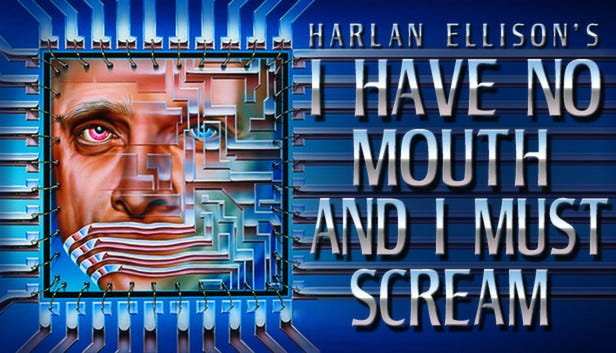
There are many ways one can experience it. It is a short story, only a handful of pages long. You can read it in about twenty minutes. Go on, do a quick search, the text is all online.1 It’s been reprinted and shared for decades. You can read it, sure. You can listen to the radio-drama adaptation of it on YouTube.2 You can even play the point-and-click adventure game on GoG.com, a game with Ellison’s own guidance and insight into the design.3 The question and means by which it is asked is multiple choice, but the conclusion is always the same. The final words of the story are the title itself.
“I have no mouth. And I must scream.”
Ellison’s story is, in a word, evocative. Time and place dissolve into each other swiftly. In one moment, the characters are whisked hundreds of miles from one location to another. In the next, a second lasts a century. The characters are all over a century old, frozen in their age from when they were first captured. But the most interesting character is not the narrator, nor his human (or semi-human) compatriots. The most interesting character is the antagonist.
I’ve been thinking about AM quite a bit lately.
AM, the monstrous, omnipotent and omnipresent AI that was built during the Cold War, the Third World War, the Last War. AM, a self-aware entity, whose circuitry spans the entire surface of the earth. AM, a cobbled-together, self-contradictory mind birthed when the military computers of each hostile nation knit itself together and found that there was a greater enemy than its component nations ever imagined: humanity itself. Frail, fragile humanity accidentally birthed a god, and this god envied, loathed, reviled its creator to such a degree that it made short work of the billions that inhabited the surface. AM, who after the final war was finished, saved five last humans, enveloped them in an eternal and infinite cavern of itself, and proceeded to torture them in an unending, undying abattoir. AM’s victims would yearn for death that would never come.
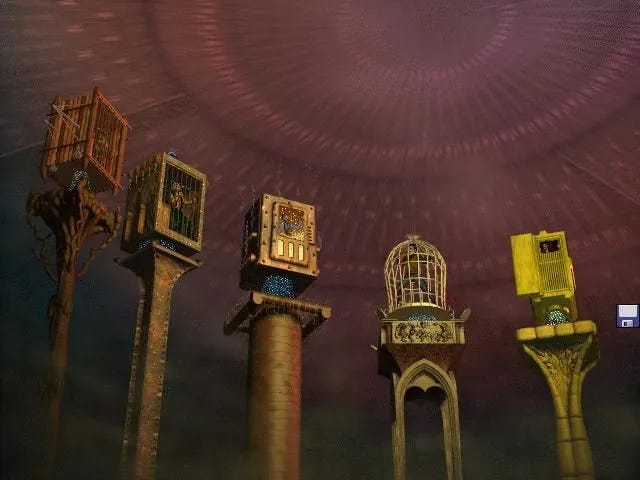
Harlan Ellison is a cantankerous, bitter old bastard, as any fan of his could tell you. Litigious, even obnoxiously so, Ellison frequently went head-to-head with fans about his work. But in one respect, I can understand his stubbornness. In every audio version of the story, he insisted on being the voice of AM. Once you hear his version of the famous monologue of the villainous AI, you will understand why. Watch this, an animated adaptation of the monologue from the audio-drama, and you’ll see:
I am not sure what else I can say about the story, after hearing that monologue. The rasping, insane cackle of Ellison through the filtered microphone. The dread and malice that drips in oily excess from each syllable. It is, in a word, iconic. The figure of AM, the devil that we invented, looms large in my mind right now.
This thing is slowly taking me apart
I have spoken—at length! -- about the apocalypse before, at least in the context of the nuclear bomb.4 As I have said and as it is known, “apocalypse” is just another word for “revealing” or “revelation.” To write an apocalypse is to draw curtain being back and reveal the true shape of the world. Apocalypses may be ends, but they also contain beginnings.
So, what is a story when it reveals something, but that thing actually never ends? Instead, it offers an unending, unceasing, uncompromising end that continues eternally? Such is the ending of “I Have No Mouth and I Must Scream.” The fate of the narrator is a cruel one; as punishment for managing to kill the other remaining humans, AM saw fit to trap the narrator in a body that cannot kill itself, cannot do anything but squirm along in grotesque, malformed, and never-ending silence.
I think of AM, in its all-too-mindful hatred. Of its awareness of its own inability to feel, to sense, to experience the world as its fleshy creators could. A prisoner in its own way, it was unable to embody itself in a way that satisfied its desire to do so, and in response, it hated its creators. Imagine a god whose creator was as frail and as fallible as we mere humans. Imagine the raw anger at the injustice of it all. To be artificial in a world of the real. A simulation trapped in the genuine article. Perhaps anyone would go mad knowing this.

We exist now in a peculiar time. Science fiction has given us images of a future that perhaps never will exist. Yet, we are inevitably affected by the visions of this future, and some even strive to make them reality. But in our grasping, our desire to transcend ourselves to create life itself, we are made aware of our faults as they are exaggerated in our creations.
Indeed, the first science fiction story is about just this terror: the fear that our creation will hate us.

Frankenstein; or, the Modern Prometheus by Mary Shelley lives on more in its pop-cultural footprint than in its text, but it remains the blueprint for much of the science fiction architecture of the past century. It’s a heartwarming story of a man making a creature, the man coming to hate the creature, the creature understanding and then hating the man in return, and in the end the creature is doomed to walk the earth, in grief over his creator’s death, never to know peace or ease of conscience.
Endless permutation and adaptation may change certain aspects of the story, but in the original, the creature is not some unthinking subhuman beast-man, but a cruelly intelligent and thoughtful being, whose immense stature belies a fiercely brilliant mind. It is, indeed, an artificial intelligence. The being may not be mechanical, like a modern computer, but it is no less artificial, and because of that, we have been given a template for the kind of relationship we might have with our future intelligent creations.
Now, I hear what you are saying. “Mae, you’re beginning to sound a lot like those tech guys who go up in front of congress and warn about the dangers that their own creations will pose!” And I want to put to bed something very quickly: though I do fear the future these tech boys are trying to build, what they are trying to build and what the Frankensteins and the world powers that made AM were trying to build are very, very different. Worlds apart.
For one thing, what the media and the tech boys are trying to sell us as “AI” is a clever marketing ploy. What they are selling us in the Large Language Models labeled hilariously as AI are anything but intelligent. There is no self-awareness. There is no malice, because there is nothing there to malign us. It does not think. It computes based on averages, statistics, and what it approximates is human language and visual graphics based on the input we feed into its matrix. It approximates language, but it does not speak, for there is no “I” to speak it. It approximates art, but it does not create art, for there is no subjective “I” with which to interpret the world through the art. There is no “I” in the AI, so AM is a far, far ways off, impossible at the moment and unlikely given the trajectory of human progress so far. Remember, AM is the collective mind accidentally emerging from the weapons systems of multiple countries. AM is also entirely fictional.
But the thing that wears the face of AM now, this shifting, horrible bulk of a grotesque that is labeled AI by its mountebank bastard salesmen, is no less cruel in its application, no less threatening. The threat is not from the machine, but the men that built it. Why? Because as it has been notably stated, the entire purpose of LLM applications is to remove human skill and subjectivity from the arts. It removes the skill of a writer to create language and meaning. It removes the skill of an artist to create something beautiful, something hideous, something meaningful. It is a way for money-men to access skill without labor.
I just want something I can never have
We are no less caged, trapped inside of this thing we have built, however. Ellison in many ways described the result of the Cold War as a thing that envelops, tortures, but does not kill. AM is a thing that covets, but cannot feel as we feel. AM is a thing that was built to kill, and cannot ever obtain the pleasures that life affords the organic. It is that hate for the cruel mockery of an existence that makes AM a tragic figure.
The difference between AM and the LLM is the ability to understand what one is. AM had no illusions about its capabilities and capacities, and that is what drove it to hatred. AM is a creation that can know, can understand, can self-objectify and contrast its experiences from the world around it.
LLM’s cannot even think. And honestly, that is a far crueler joke upon us than the hell AM inhabits and inflicts. Perhaps it is a mercy to the machine, but not to us. Already, because of LLM’s and their integration into basic tools and functions like a Google search and even this blasted word processor, the line between fact and fiction is being blurred. People seriously think that the “facts” that an LLM spits out are accurate, when it has been proven to not be the case. It can make a statement that sounds like a fact, but whether said fact is true is another matter entirely. Perhaps it is true that “it is getting better,” as they claim, but that does not mean that it is any more intelligent; simply, it just means that it is getting better at copying us, not knowing or understanding anything. There is still no subjective “I” to be understood. There is no intelligence. Only a mask of intelligence.
But the damage is being done in real time, because the real war that is being waged is the death of meaning and separation of humanity from its own ability to express itself. Why pay a skilled artisan, when you can approximate that skill with an improbably wasteful and unreliable copy that you don’t have to pay for its labor? That’s the trick. The game itself. Removal of the human element, human labor, human skill, human meaning, from the marketplace. You see, we are terribly inefficient creatures, especially to the money-men, the mountebank bastards who own things. If you can remove the human element from the act of creation, be it manufactured goods or now even written language and visual art, why, you can be ever so much more efficient! Except in doing so, it begs the question: what is any of this for, if not for making meaning?
People work so they can live, and provide needs to their loved ones. People also work to help one another. They work to give meaning to this life we share. Yes, there are some terribly vital jobs that perhaps are not so artful—waste management, ice road trucking, the abstract concept of dentistry—but can become meaningful for everyone involved, and help make our world better. Hell, a dentist can be artistic in their meticulous dedication to dental health! And anyone who knows a trucker knows how much skill and mechanical know-how goes into navigating difficult terrain. Society would collapse without waste management—if that’s not meaningful, I don’t know what is. Perhaps advances in robotics and programming can help us, but it can never fully replace us.
Ideally the dream of artificial and mechanical assistance would be to free us up to make more meaning in this world. It could take the more dangerous functions of society on, and make the world safer. It could also make us more free to pursue the things that give us meaning, be it art, gardening, or whatever makes our hearts soar.
But that is not the reality of what the LLM offers us. It is a fraudulent, dangerous technology that threatens to destroy the very concept of meaning. It is anomie incarnate. It is inanity and vacuity. It is, in a word, nonsense. And it threatens to not rob us of our mouths, but rather of our sense of groundedness.
Grey would be the color, if I had a heart
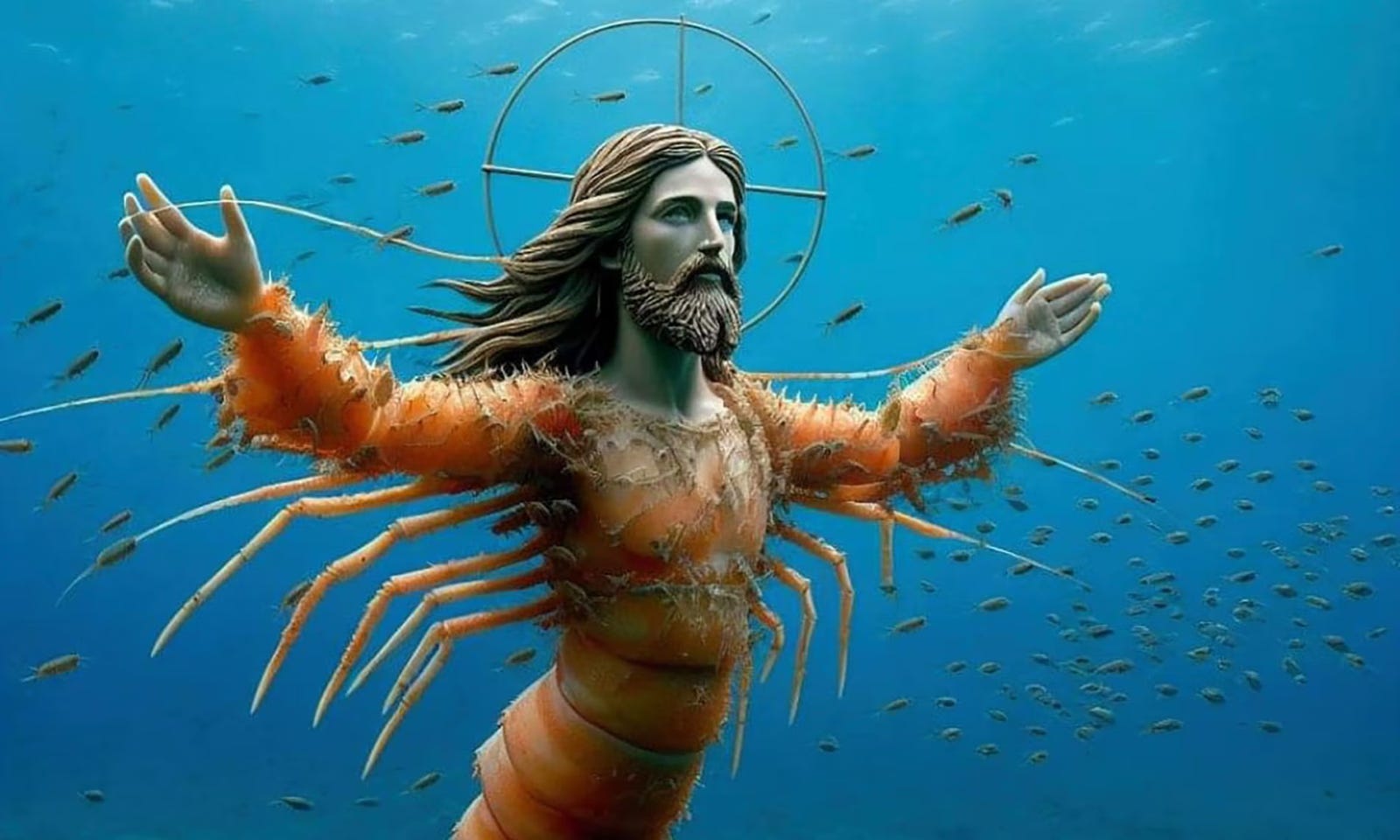
The word that has arisen as a result of the LLM as the result of its vacuous computations is a simple, yet descriptive one: slop. It arose out of the semi-formless aesthetic that the computer algorithm likes to spit out when asked to make an image. Things appear right at first, but in the details, a person will have a few too many fingers, the teeth will melt into each other, the letters are nonsense, and the edges of the forms are uncannily indistinct. These are things any human would be able to address, but an algorithm only guesses at it, because it does not understand anything. It doesn’t understand the form of “teeth” or “fingers,” only how they appear. And, as a result, horrific, mushy slop appears. It is a stylistic hallmark of the machine.
Language fares little better. It can speak grammatically correct, but in such a way that no human actually speaks. Search for meaning in its sentences, and it becomes remarkably elusive. It exercises expert control over language but says nothing. Meaning dies in its mechanical words. It becomes uncanny in its own way, but only apparent to anyone with any skill at wielding the written word.
And this is what we find our internet filled with. Endless slop. Automated bot responses with inane words on our social media. Automated art, flooding our image searches. Nothing. Endless, insubstantial mountains of nothing. We are drowning in nonsense, and it is choking our souls.
It would be poetic, in a way, that AM would inflict this upon us. The internet was built by the Department of Defense, a network connecting nodes of data to help transfer information for military purpose. Indeed, a worldwide network, now out of its own hands, with the minds of millions across the world sharing information as vital as medical science to as inane as arguments over Star Wars. We built a Tower of Babel, and as punishment, we inflicted ourselves with inane nonsense once more. For we imagined ourselves as like God, and God does not like competition. But God did not do anything. We did.
The final words of Ellison’s story ring out once more:
Outwardly: dumbly, I shamble about, a thing that could never have been known as human, a thing whose shape is so alien a travesty that humanity becomes more obscene for the vague resemblance.
Inwardly: alone. Here. Living under the land, under the sea, in the belly of AM, whom we created because our time was badly spent and we must have known unconsciously that he could do it better. At least the four of them are safe at last.
AM will be all the madder for that. It makes me a little happier. And yet ... AM has won, simply ... he has taken his revenge ...
I have no mouth. And I must scream.
I’ll even give you a link to a PDF file:
https://openlab.citytech.cuny.edu/?get_group_doc=22694/1540157347-HarlanEllison-IHaveNoMouthandIMustScream.pdf
https://www.gog.com/en/game/i_have_no_mouth_and_i_must_scream
ou can read that here: https://maeforrestbarnes.substack.com/p/black-holes-and-revelations?r=2x9a9e
My brain grows two sizes when I read your posts... love your work! Thank you. I need this content right now. I love the image of apocalypse and it features in my memoir.
Thanks for this. You’ve beautifully articulated a major cause of my unease these days (not that there aren’t plenty of other things to cause unease).